DragonsEye


To us all a full life and a fair measure of prosperity, happiness, pleasure and joy until we are visited by the lord of death, the destroyer of delights and the one who parts companions.
There is gold at the end of some rainbows. Gold beyond imaginings.
But this time the dragon beat me there. I had to watch from a safe distance while the dark alfs scattered and the dragon picked up the gold and flew off.
You said - I thought dragons were your friends and would surely share the spoils.
I said - Some people say you can train a dragon to come at a whistle.
Some of the old farmers say dragons can fly you around a bit – and do useful things like put in a fire break. Some farmers in the mountains use dragons to retrieve straying sheep. Some claim you can even sit back and swap the odd story with a dragon.
I said - To be sure, if it suits their purposes, maybe they might toss you into the air for fun. But when it comes to gold, the blinkers come down and it is every dragon for itself.
You said – Oh is that so? You spin a nice yarn and the beauty is that it is so believable.
I said - I am just going on what others tell me about their dragons. I try to keep things fair.
Based on hard evidence, I grimace. The dragons I normally have to deal with are just plain ornery. Perhaps unfairly, I suspect that will be the case with the one who got my gold today.
Then, perhaps unwisely, I said - Maybe I should go ask if it is happy to share some of the gold.
So here I am. In the Dragon’s lair. Under the ground.
We have been waiting here a little while.
You say - The dragon must be asleep by now. Go get the gold now, I cannot wait any longer.
I whisper - I am not sure. I think its eyes are still a little open.
You say - You are completely safe. Quick, before the others come back.
I say - It is ok for you, you are on the other side of the world.
You say - Come on - you said it would be fun. All that gold.
I say (a little louder) - it is a bit more complicated. Dragons eat people.
A tinkle in the distance.
You say - I do not believe in dragons anyway. It is just another one of your stories.
I look at the dragon, and it looks back at me.
You say - I would not have sent you into the dragon's lair for gold.
I froze.
This lair was inside a hill. Not far into the hill. Over the years, water from a creek had melted away the limestone in the hill and created one largish cavern, with a collapsed roof. A mix of light and rain was streaming in from the roof – together with occasional flashes of lighting.
I had explored this creek cave before the dragon set up home.
I would not have put a lair here. When it starts to rain, like now, the creek starts to rise. Things get damp.
There were a couple of ways into the cavern.
The dragon probably used the collapsed roof to get in and out most of the time. It had also dug out the creek cave downstream – probably so the water would drain out.
I had come in the third way – crawling next to water through the low creek cave upstream. I had thought it a good plan, but looking at how the dragon had burrowed through the creek cave downstream, I was not as sure.
The dragon had made itself fairly comfortable. A resting place on a ledge getting the sun without the rain, tree ferns around, limestone crystals sparkling on the rock wall behind and – of course - the gold.
The dragon might have heard me talking to my mobile (there was a little reception here, perhaps because of the collapsed roof). Or maybe it felt me looking at the small cache of gold. Silently, it rose to its feet.
It was pretty big when it stood up. Legs made for leaping and running, super sharp talons on the ends for ripping.
The first inclination you always have, when seeing a dragon looking at you, is to run.
So I turned and, forgetting to duck, ran straight into the wall of the cave, just above the low creek cave upstream.
The two cats ran as well. Waylander, sensibly, ran back into the low cave passage we had snuck in through, with the speed of a small elephant. Blanket, who had been having a quick nap, and who was still waking up, ran the other way - towards the dragon.
When going into a dragon lair, you should try to cover against all the possibilities. Be prepared. I should have brought, for example, a fire extinguisher. I should not have brought the cats.
My grand-aunt Victoria Edmonstone, who was not a fan of cats nor finance, would take me as a young child to wonderful places to watch the dawn or setting sun and recite me lines from the poets. One sunrise, listening to the morning song, she taught me-
All that glistens, is not gold.
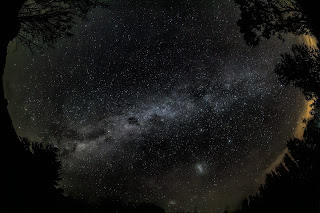
Australian sunrise and sunset are noisy. Kookaburras laugh and magpies sing, as sheep quietly move towards the sun. At night, as you remind me, there are riches in the sky, just out of reach. As a rule, sunsets and sun rises and night-times don’t need gold - and they do not have dragons.
My head was full of pain, I could not move, but I could just make out the light streaming in from the collapsed roof of the cavern – onto the little pile of gold. The glistening gold and my grand-aunt’s words started to swirl.
I spent a lot of time with my great-aunt Victoria Edmonstone as a small child. Her seanathair (old father or grandfather) came from Ireland. A doctor, he disappeared in the Victorian goldfields after the Eureka stockade uprising.
She was the first to tell me about the little people, the dark alfs.
She thought that they lived in red mushrooms in the deep woods. She was sure that they collect vast stores of gold coins and travel the sky using rainbows. They bury their loot at the end of their rainbows.
Not any rainbow. A normal rainbow flickers into existence as sunlight hits water vapor. They glow and fade as rain clouds clear the sky. The rainbows of the dark alfs emerge after fierce lightning storms, while the static electricity still hangs in the air, setting your hair on edge. Their rainbows come from the sky like meteors, hitting the ground with an explosion of light, leaving a faint rainbow trail as mist rises.
My great-aunt Victoria Edmonstone loved rainbows and would chase them with great determination. Like the dragons. And yet again I saw her looking into my eyes, shaking her head, and saying all that glistens, is not gold.
Surprising what can come to mind when you are in a cave with a dragon about to eat you. I could feel the lump starting to form on my head as I came out for the second time. With the vibration of the dragon chasing something, punching roles in the cave wall.
I scrabbled down into the passage, hoping for the second time in an hour there were no snakes in the dark passage. I scraped a rock off a shelf. It clattered down and fell, with a splash, into the water. The sounds behind me stopped.
I believe everything my great-aunt told me - and so I have always chased rainbows as well. When it storms in the mountains I go hunting the dark alfs. Up the winding road, towards the deep woods. Waiting for the rainbows that fall like meteors.
If I got out of this, I quietly told myself, no more rainbows. Never! It was time to give gold a miss.
Waylander was still padding slowly and carefully ahead, testing every small pool, and lifting her snout to test the air.
Suddenly the passage behind me shuddered, small rocks fell from the roof. The dragon was following, trying to dig me out.
Something was coming up the path behind me fast. Blanket shot past me like a bat.
The entrance was just ahead. The soft light of late afternoon. The smell of a summer storm and static electricity.
The thunderstorm had just passed.
Waylander paused at the entrance, Blanket now alert, was crouched and wide awake, a faint spiral of smoke rising from her tail. A second dragon in the distance gave call.
One moment there was just the creek bed, tree ferns, and a grassy patch next to a pretty little creek. Next the dark alf rainbow hit the grassy patch just outside the cave. There was an explosion of light and a faint rainbow trail extended high into the sky. Mist started to rise.
The dragon was still fighting its way through the rock behind us. I ran along the creek towards the rainbow, dark alfs scattering everywhere. This time I would get to the gold first.
As I ran, the net spluttered back into life and I heard you say – Funny, the connection dropped for a second there. Forget the gold. Go get a proper job. Are you still there?
I took a deep breath – You are right. I am going to have to rethink the whole gold thing.
In the fraction of time before disaster struck, I noticed that Waylander had grabbed a couple of dark alfs along the way. She gave me her guilty look.
The cats and I hit the rainbow just as the dragon exploded out of the hill.
(No dragons or cats were hurt writing this part. Some of the tree ferns got scorched, one of the dark alfs lost a bit of an ear and I got a bump.)
Note that a sequel to the story is in preparation and is available Sequel.
Today, work commenced on turning this story into a film and the first musical scores for the piece were created:
Ignis. Terra. Aer. Aqua.
Oculus Draconis videt omnia.
-
When I was young, she spoke in rhyme
Of a woodsman lost in time
The haft of his axe, a rotted ghost
A thousand years, forever lost
-
Just imagine that!
The theft of a life
Curled in a seat with a song in mind
Just out of reach.
-
A year went by before I saw
The farmhouse just beyond the creek
She trained her horses, kept her
peace
While I worked for the state I once tried
to cease
-
A hard continuous slog
To shape each idea
To solid cold reality
Responsibility
-
I crashed!
In the half haze, I tried
But I began to fail
More often than succeed
More often than succeed...
-
Just imagine that!
The theft of a life
Curled in a seat with a song in mind
Finally in reach!
-
Ignis. Terra. Aer. Aqua. Oculus
Draconis videt omnia.
Upon the peaks where shadows sleep,
A fire wakes in mountains deep.
"Dragons Eye Dyptych" by Peter Quinton, is a fantastical narrative set in the Tallaganda region of South East Australia and the Canterbury Plains in New Zealand. It intertwines themes of adventure, mythology, and personal relationships, featuring humans, mythical creatures like dragons, aelfs, wraiths, and Crest beings.
The story follows several characters, including Kathy, a farmer; her daughter Storm, a horse trainer; Anthem, Jon's online acquaintance; and Bob, a New Zealand drifter. The plot revolves around their encounters with dragons, aelfs, and other mythical beings, as they navigate a world threatened by chaos, war, and invasions from spider-kin and Crest beings.
Key elements of the story include:
- The existence of nine interconnected worlds, influenced by past stellar encounters, which have left them entangled and vulnerable to invasions.
- The concept of "dragon taint," a genetic modification by the aelfs that turns individuals into powerful but uncontrollable dragons.
- The struggle to control the dragon taint and the consequences of its effects on the characters, particularly Jon and Anthem, who are transformed into Black Dragons.
- The quest to rescue Kathy, who is trapped in the spider realm, and the need to assist the Crest in their battle against the spider-kin on their homeworld, Terrorfar.
- The complex relationships between the characters, including Anthem's love for Jon, her jealousy over his past connection with Kathy, and the revelation that Anthem is pregnant with Jon's dragon-tainted children, Fire and Ice, who possess unique abilities and communicate with their parents.
The story explores themes of love, loss, identity, and the struggle between chaos and order. It is rich in vivid imagery, mythical lore, and emotional depth, blending elements of fantasy with personal and cultural reflections.
The document also includes an afterword, providing insights into the author's life, the setting of the story, and the inspiration behind the narrative, particularly the influence of the author's great-aunt, Catherine Victoria Edmonstone, who loved storytelling and adventure.



Comments